
Type above and press Enter to search. Press Close to cancel.
In the world of government contracting, opportunities are plentiful - but so is the competition. Countless contractors bid for the same task orders and delivery orders, each hoping to convince federal agencies of their competency, because quite literally, their company's future depends on demonstrating value to federal buyers and potential teaming partners.
The businesses that consistently win are not operating on speculation. And contrary to popular assumption, they are not always the ones with the strongest technical capabilities or the most impressive past performance. More often than not, they are simply the ones who communicate their competencies and past performance most effectively. They have learned how to convince agencies and contracting officers that they can solve their problems.
A government capability statement is a key ingredient in that strategic communication. It is not the only critical ingredient but it is every bit as essential as salt is to a good chicken parmesan. More often than not, your capability statement can be the make-or-break factor in winning over agencies and potential teaming partners.
A government capability statement is not a brochure and that needs to be said upfront, because most businesses design theirs as exactly that: a brochure listing the services they offer. If this has been your approach so far, understand that it may have quietly disqualified your business from opportunities where you had the technical expertise but failed to communicate it effectively.
So if a capability statement isn't a brochure, what is it?
It is a marketing and business development tool used to communicate to agencies and potential teaming partners that your company can help solve their problem. It is a snapshot of information that prime contractors and agencies scan to either qualify or disqualify you for an opportunity. The operative word here is scan a strong capability statement must be easy to scan for relevant information at a glance.
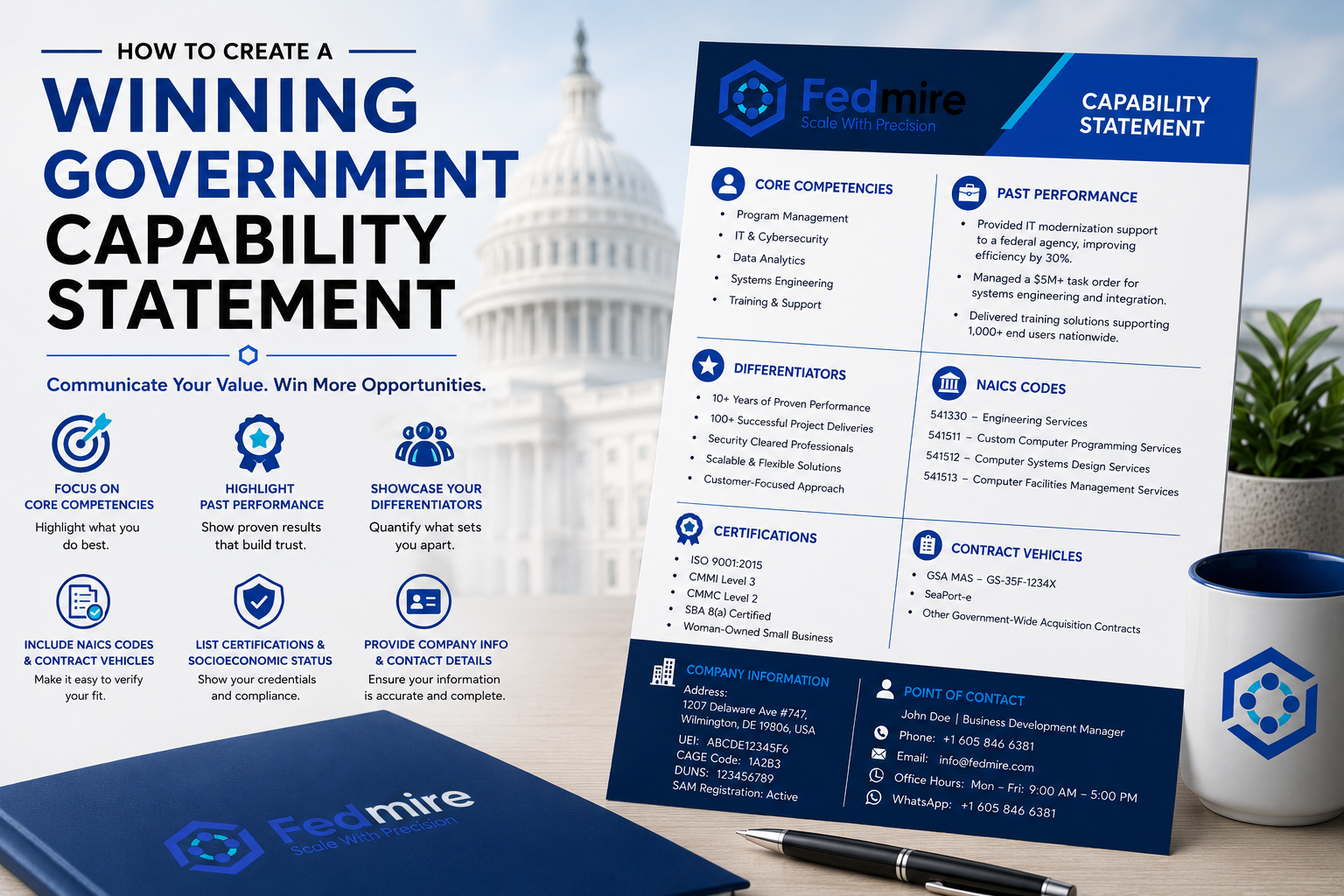
Only include your primary, core areas of expertise don't overload your capability statement with an extended list of every service you offer. A long, unfocused list of core competencies signals a lack of confidence and depth to agencies and prime contractors, rather than versatility.
Not every achievement, large or small, needs a place on your capability statement. The best practice is to maintain multiple versions of your capability statement, tailored to different agencies and opportunities, each highlighting the past performance most relevant to that specific audience.
Your differentiators should be quantifiable and objective. Vague claims like "high-quality services" or "experienced team" raise more questions than they answer. Instead, cite specifics: years in operation, number of task orders successfully executed, cost-effectiveness, surge capacity, risk management capabilities, geographic coverage, security clearances, and any other measurable competitive advantage.
If there is one element your capability statement cannot afford to omit, it's your NAICS codes. Too many capability statements either leave out NAICS codes entirely, omit contract vehicles, or bury the document under an excessive list of codes. The strongest capability statements clearly distinguish between primary and secondary NAICS codes and keep that list focused and relevant.
Your socioeconomic status and certifications give you a genuine competitive edge. They help contracting officers track their award goals, and they signal to potential teaming partners the advantages of working with your company on a given project. If you hold certifications such as CMMI, CMMC, ISO 9001, or FedRAMP authorization, they speak to your operational maturity and reduce perceived risk for agencies and partners alike.
Provide a brief, accurate description of your company, along with your logo, DUNS number, and CAGE code. Include the contact information and title of your point of contact and it's good practice to also list your CEO's name and contact information. Don't forget your SAM registration status and UEI number, so contracting officers can verify your information immediately.
Ultimately, a capability statement exists to help government decision-makers quickly understand who you are, what you do, and why your company deserves consideration for future opportunities.
Many small businesses invest far more time and budget into their website than into their capability statement yet the capability statement is usually the first document a contracting officer reviews before deciding whether to continue the conversation at all. A well-designed website matters, but it deserves no more attention than your capability statement.
Agencies collect capability statements in response to Sources Sought Notices (SSNs), RFIs, and pre-solicitation notices. They rarely, if ever, collect websites for market intelligence.
A well-prepared capability statement opens doors long before a solicitation is even released. It's a must-have for industry days, networking events, and responses to Sources Sought Notices or pre-solicitations so keep both a digital and print version on hand at all times.
Your capability statement is your business's resume. Developing a strong one is among the most valuable investments any contractor can make. Don't confuse it with a company profile: a company profile is about your company, while a capability statement is about your customer's needs.
At Fedmire, we help government contractors develop professional, results-driven capability statements that support every stage of the government contracting process. From capture planning to writing winning responses to RFPs and RFIs, our proposal team works closely with yours to ensure your business puts its best foot forward for every agency and government opportunity.